The two schemes you will meet
IRATA (Industrial Rope Access Trade Association) is the international scheme most common outside North America and widely recognised in Canada. SPRAT (Society of Professional Rope Access Technicians) is the North American scheme. Both use three levels, both require periodic recertification, and both are accepted by most building owners and insurers.
Many technicians hold both. Track each certification separately with its own number, level, issue date, and expiry date, because they do not renew together.
What each level means on site
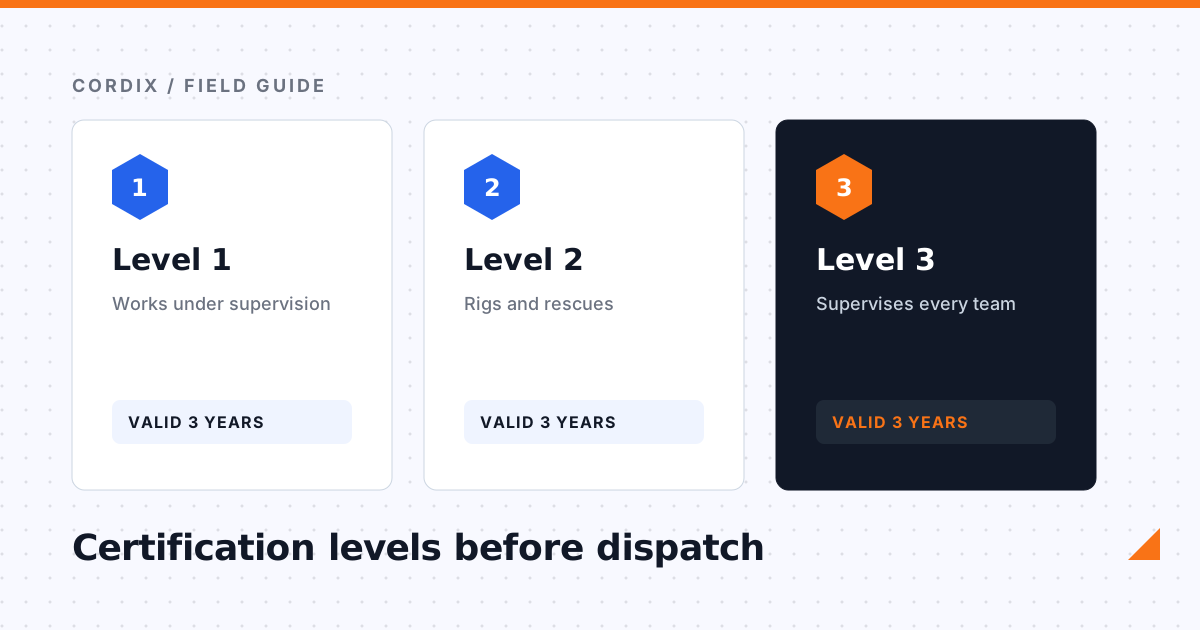
Level 1 technicians can perform rope access work under supervision. They cannot supervise others and should not be rigging anchors alone.
Level 2 technicians have more rope hours, can rig complex systems, and can perform rescues, but still work under a Level 3.
Level 3 technicians are supervisors. Under IRATA a Level 3 must be present and in charge of every rope access team, and a team is never fewer than two people. SPRAT has an equivalent supervision requirement. If your schedule puts a crew on a building without a Level 3, the job should not start.
Expiry and the logbook
IRATA and SPRAT certifications are valid for three years. Progression to the next level under IRATA requires a minimum of 1,000 logged hours and at least twelve months at the current level. Those hours live in the technician's logbook and must be signed off by a Level 3.
A coordinator does not need to audit logbooks, but the scheduling system does need to know each technician's level and expiry date, and it needs to refuse or flag an assignment when the expiry falls before the job's end date.
The pre-dispatch checklist
Before confirming a crew for a shift, verify five things: every technician on the roster holds a current certification; at least one is a Level 3 who is named as supervisor; the crew size is at least two; any task-specific tickets the client requires, for example first aid or fall protection, are also current; and the technician's profile matches the person who will show up.
The last point matters more for companies using subcontracted technicians who work across several firms. One profile per technician, owned by the technician, prevents the same person appearing with three different expiry dates in three different spreadsheets.
Keep the evidence where the client can ask for it
Property managers and general contractors increasingly ask for proof of certification before granting roof access. Keep a scan of each certificate attached to the technician profile with the expiry date as structured data, so the office can answer a compliance request in minutes and so the system can warn you 60 days before a renewal.
Certification checks at scheduling time
Cordix stores each technician's certifications with expiry dates and checks supervision coverage when a crew is assigned to a shift.
Request a demo